Mumbai's Mobility
Decoded with Data
Understanding how 28.18M+ people navigate India's busiest city every day through comprehensive transport analytics.
28.18M
Population
34 min
Avg. Travel Time
10.5M
Daily PT Riders
17.9 km/h
Avg. Speed
Where Mumbai Lives & Works
A massive spatial mismatch exists between where Mumbaikars live and where they work, creating enormous commute pressure.
Loading map...
Spatial Mismatch Alert
High-density residential areas in the suburbs and eastern corridor are disconnected from major employment hubs, creating extreme peak-hour congestion on local trains and highways.
Density Scale
Key Numbers
City Infrastructure
Major Employment Hubs
Source: Directory of Establishments data 2014 and Census 2011
The Daily Rhythm of Congestion
Mumbai's transport network follows predictable patterns. Understanding these rhythms is key to survival.
24-Hour Congestion Pattern
6:00 AM
Early Risers
20% congestion
7:00 AM
Speed: ~22 km/h
45% congestion
8:00 AM
Speed: ~19.4 km/h
75% congestion
9:00 AM
Extra time: +6 min
85% congestion
10:00 AM
Still Heavy
65% congestion
11:00 AM
Easing Off
40% congestion
12:00 PM
Midday Lull
30% congestion
1:00 PM
Lunch Hour
35% congestion
2:00 PM
Afternoon
30% congestion
3:00 PM
Picking Up
35% congestion
4:00 PM
School Rush
50% congestion
5:00 PM
Evening Begins
75% congestion
6:00 PM
Speed: ~14.2 km/h
90% congestion
7:00 PM
Extra time: +18 min
95% congestion
8:00 PM
Late Commuters
70% congestion
9:00 PM
Free flow: 24.4 km/h
45% congestion
10:00 PM
Night Mode
25% congestion
Real-time congestion data arriving shortly
Morning Peak
7:00 AM - 11:00 AM
Speed drops to 19.4 km/h, adding +6 min to commutes
Evening Peak
5:00 PM - 9:00 PM
Worst congestion at 14.2 km/h, +18 min extra time
Free Flow
9:00 PM - 5:00 AM
Speed reaches 24.4 km/h during night hours
Source: Data not available
How Mumbai Actually Moves
Understanding the mode share tells us about infrastructure gaps and opportunities
Walking
Mode share
Metro/Suburban Rail
Mode share
Bus (BEST)
Mode share
Two-Wheelers
Mode share
Auto-rickshaw
Mode share
Car
Mode share
Cycling
Mode share
The Local Train Overcrowding Crisis
At 38%, Mumbai's local trains carry 7.5 million passengers daily—the lifeline of the city. However, this creates severe challenges:
- •Extreme overcrowding (14-16 passengers per sq meter)
- •Safety concerns with 2,500+ annual accidents
- •Peak-hour saturation on Western & Central lines
Metro & Integrated Transit Vision
Mumbai Metro expansion (14 lines planned) combined with coastal road projects can transform mobility:
- Metro share projected to reach 15-20% by 2030
- Reduced pressure on suburban trains
- Improved east-west connectivity
Source: CTS 2021
Infrastructure Supply Analysis
Analyzing road network capacity and travel patterns across Mumbai's urban infrastructure.
Road Widths
Average Travel Distance
Source: Derived from OSM
Major Job Clusters & Friction Points
These employment hubs create massive commute flows, overwhelming our infrastructure during peak hours.
BKC
Bandra-Kurla Complex
Primary Industry
Banking & Finance
Intensity
ExtremeAvg. Distance
xxx
Peak Delay
xxx
Andheri MIDC
Seepz & Andheri East
Primary Industry
IT Services
Intensity
HighAvg. Distance
xxx
Peak Delay
xxx
Vikhroli-Godrej Complex
Integrated Township
Primary Industry
Corporate HQs & Tech
Intensity
HighAvg. Distance
xxx
Peak Delay
xxx
Powai-Hiranandani area
Tech Park Complex
Primary Industry
IT & Software Services
Intensity
Medium-HighAvg. Distance
xxx
Peak Delay
xxx
Kandivali
Industrial Belt
Primary Industry
Automotive Industries
Intensity
MediumAvg. Distance
xxx
Peak Delay
xxx
The Commute Tax: Time & Productivity Lost
Workers traveling to these high-intensity clusters lose an average of 27 minutes per trip during peak hours compared to free-flow conditions. For a typical commuter making 2 trips daily, that's nearly 1 hour lost every day—or 220+ hours annually.
xxx
Daily Time Lost
xxx
Annual Time Lost
xxx
Economic Cost
Source: Comprehensive Mobility Plan for Greater Mumbai, CMP 2016
Urban Road Network Analysis
Comparative analysis of road network accessibility and average travel distances across major Indian metropolitan cities.
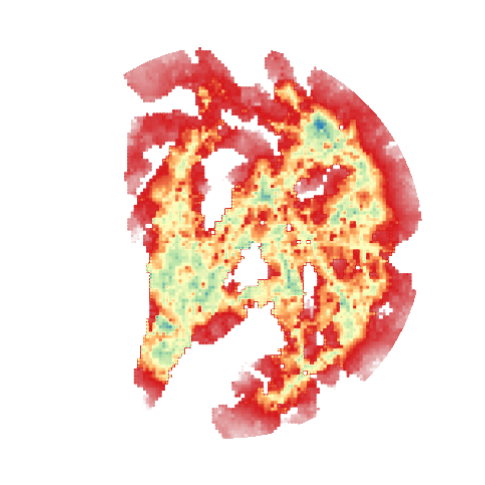
Mumbai
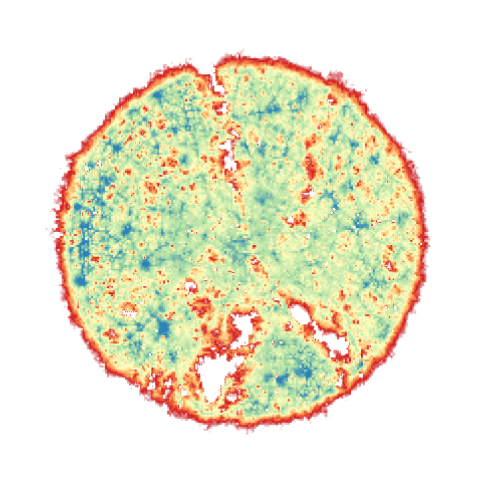
Delhi

Ahmedabad
Source: Derived from OSM
Road Accidents
Understanding accident patterns to make Mumbai's roads safer.
Fatalities
Serious Injuries
1,895
Total Accidents
371
Fatalities
1,671
Serious Injuries
Source: Ministry of Road Transport and Highways - Road Accidents report 2022
Mumbai vs Other Metro Cities
How does our mobility landscape compare to Delhi and Ahmedabad?
Modal Share Comparison
Hover over each category to explore
Mumbai Strengths
Highest walking share among metros, promoting sustainable mobility
Suburban rail carries 10.481M daily passengers - highest in India
Areas for Improvement
Current fleet: 3,166 buses, target: 16,908 buses
Highest among major metros - scope for improvement
Source: Master Data Sheet for TAH (City Comparison metrics)
Learning from Other Cities
Mumbai Advantage
Highest PT ridership at 10.481M daily. 23% use Metro/Rail - the backbone of urban mobility.
Delhi Integration
Fleet of 7,683 buses. 10% Metro usage with expanding network.
Bangalore Growth
6,340 bus fleet. High 2W usage (35%) shows need for better PT.